
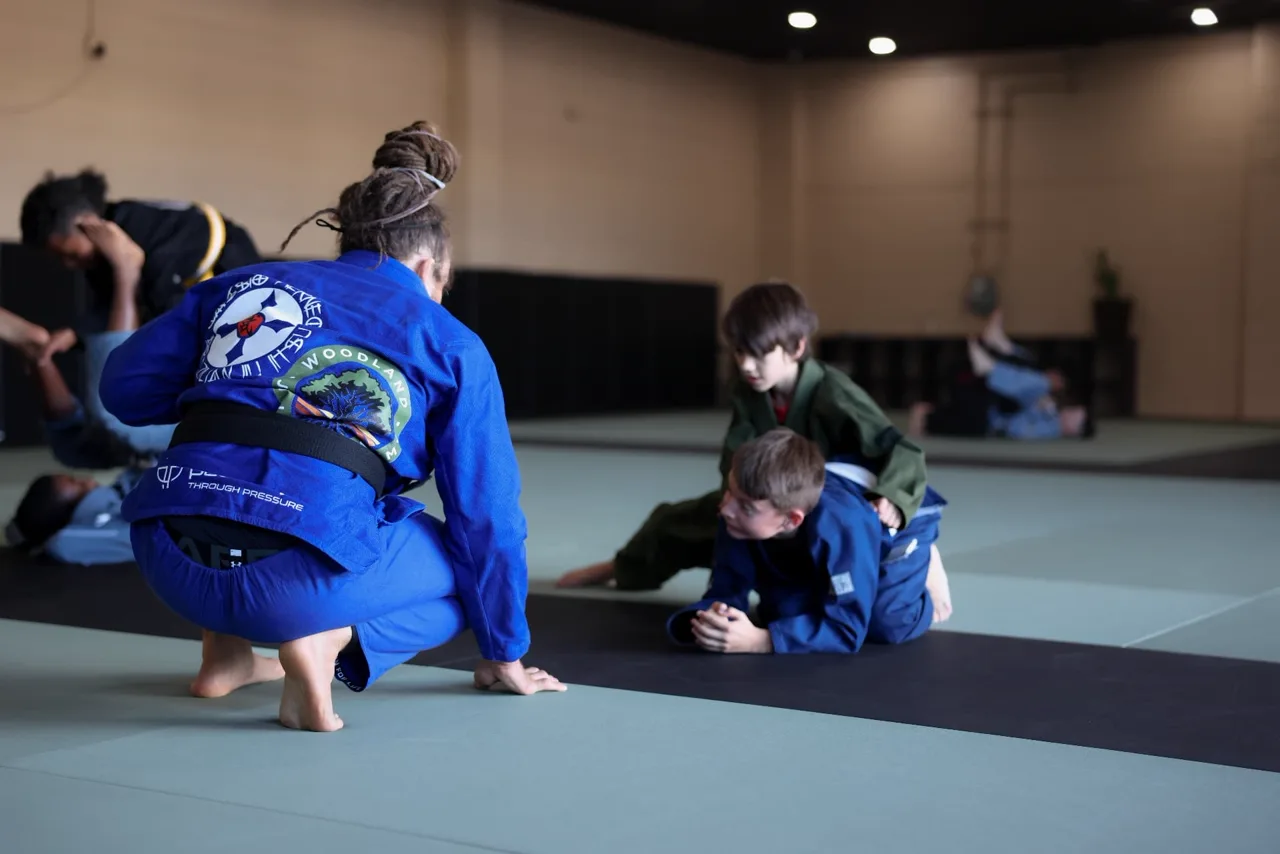
What Jiu Jitsu can teach our kids about the people they are becoming
Every few weeks, a message like this lands in our inbox. The wording changes, but the shape never does:
"Hey coach, I think we're going to pause things for a while. She's just not into it anymore and I don't want to make her do something she's not enjoying. Thanks for everything, the kids love you guys."
There is nothing wrong with that message. It's kind. It's honest. It comes from a parent who loves their kid and doesn't want every Tuesday afternoon to turn into a fight.
But before you send it, there's one question worth sitting with:
Does my child need to leave, or do they need help getting through a hard part?
From the back seat of the car, those two things sound exactly the same. "I don't want to go anymore." Learning to tell them apart might be one of the most important things you do as a parent this year.
Some things aren't optional
Most activities in a kid's life are a choice. Baseball, soccer, piano, dance, art class. They try it, and if it doesn't take, they move on. That's healthy. Nobody needs to be forced through six seasons of Little League.
But there's a shorter list of things we don't put to a vote.
Reading. Math. Learning how money works. Knowing how to swim. A nine-year-old doesn't get to opt out of fractions because fractions were frustrating on Thursday. We push through, because we know what it costs an adult who never learned.
Here's the thing most families leave off that list: knowing how to protect yourself.
Not in a movie sense. In the real sense. Being calm when someone bigger grabs you. Knowing how to get up, get away, and stay in control of your own body. Every child will grow into an adult who walks through parking lots, goes to college, travels, dates, and eventually looks after kids of their own. Life will test them on this at some point, and the test won't be optional.
That's why we think about Jiu Jitsu differently than we think about a sport. Jiu Jitsu is the one martial art built around the situation people actually end up in: on the ground, under pressure, against someone stronger. It teaches a kid to stay composed in exactly the moments most people panic. In our view it belongs in the "not optional" column, right next to learning to swim.
Baseball is something a kid does. Jiu Jitsu is something a kid needs to know. That difference should change how we react when they say they want to stop.
And unlike math, it comes bundled with everything else on this page.
Every kid needs a hard thing
Life gets hard. Not might. Will. There will be a class they don't understand, a boss they can't please, a friend who moves away, a job that falls through. Nobody gets to skip that part.
The question isn't whether your child will face hard things. It's whether they'll have any practice when they do.
That's what a "hard thing" is for. It's a place where a kid learns, in a safe setting with adults who care about them, what it feels like to:
- Show up when they don't want to. Most adults who train will tell you the same thing: they rarely feel like going, and they're always glad they went. Kids can learn that pattern early. Feelings before an effort are a bad predictor of how you'll feel after it.
- Solve a problem while it's still uncomfortable. On the mat, a kid gets stuck in a position and has to think their way out, right now, with someone on top of them. That's problem-solving with real stakes and immediate feedback.
- Be bad at something and keep going. Every white belt gets tapped over and over. Learning that being a beginner isn't an emergency is a skill that transfers to everything.
- Lose, reset, and go again. Tapping is a safety skill, but it's also a lesson: you can stop, protect yourself, learn something, and come back for the next round. Losing isn't the end of anything.
A well-run class delivers all four of these in an hour. A frustrated kid in that class isn't a sign something has gone wrong. Often it's a sign the class is doing its job.
Other activities can teach these things too. What makes Jiu Jitsu unusual is the combination: physical challenge, close cooperation with a partner, instant feedback, and learning to think clearly while under pressure. Few things a child can do at age 8 check every one of those boxes.
The research backs this up
This isn't just gym-owner opinion. There's real evidence that what happens on the mat carries into the rest of a kid's life.
Jiu Jitsu changed how kids behaved in the classroom. In a randomized school trial in Abu Dhabi, 88 sixth-grade boys were split between Jiu Jitsu classes and regular PE for 12 weeks. Teachers, who didn't know which group each kid was in, rated the Jiu Jitsu students as having fewer emotional symptoms, less hyperactivity and inattention, and fewer overall behavior problems. It was one school and one semester, so treat it as a strong hint rather than a final word. But the hint points in one direction.
Martial arts training improved attention and conduct in a bigger study. A randomized trial of 240 UK primary students found that an 11-week beginner Taekwondo course left kids with better attentional control and fewer teacher-reported conduct problems than classmates who did regular PE. Different art, same theme: structured martial arts training helps kids practice self-regulation.
And self-control in childhood predicts the adult. The famous Dunedin study followed 1,037 children from birth into their thirties. Kids who showed more self-control early in life were healthier, wealthier, and less likely to be in trouble as adults, even after accounting for intelligence and family background. That study didn't test Jiu Jitsu. It tested whether skills like managing impulses and following through actually matter down the road. They do, enormously.
None of this proves that dragging an unwilling kid to class produces a better adult. What it shows is that the skills Jiu Jitsu practices, week after week, are the ones that shape the rest of a life. That makes a rough month a poor reason to walk away from them.
Sometimes leaving is the right call
Let's be clear about what this is not. This is not "never let your kid quit anything."
Injury. Bullying. A coach who isn't safe. A kid who is genuinely distressed, or has been unhappy for months, not weeks. Those need action, and no lesson about toughness excuses ignoring them. If the fit is truly wrong, a different activity is the right answer, and we'll help you find one.
But "I don't want to go" usually isn't that. Usually it means one of these:
- They got tapped by a smaller kid and felt embarrassed.
- Progress feels slow and they can't see it yet.
- They're tired after school and the couch is winning.
- A partner is rougher than they like, or a friend switched to a different class.
- They hit the point every beginner hits, where it stopped being new and started being work.
Every one of those has a fix that isn't cancelling. And every one of them is exactly the kind of problem we want kids to learn to work through, because they'll meet the same problem again in a classroom, on a team, and at a job.
If we end a worthwhile thing the moment it stops being easy or exciting, we teach a kid that hard equals wrong. We also rob them of the part that comes next: the click of understanding, the friendship, the first small win they'd stopped believing in.
What to do instead of cancelling
Support is part of the challenge. Kids don't push through hard things alone; they push through with an adult beside them. Here's a plan that works.
1. Ask before you answer. "I don't want to go" is the headline, not the story. Get the story. "What's been hard lately?" Then be quiet long enough to hear it. A kid who feels heard is a kid who can be helped.
2. Give them a reason they can understand. "Because I said so" tells them nothing about what the effort is for. Try this instead:
"I hear you. Tell me what's been hard. We do this because learning to handle hard things matters in our family. You don't have to be the best, and you don't have to get it right. Let's talk with your coach, figure out what would help, and check in again in a month."
3. Loop in your coach. Tell us. Seriously. We can move a partner, adjust a class, set a small goal, or just keep a closer eye on a rough week. Most of the reasons kids want to quit are things we can fix in a class or two if we know about them.
4. Make one adjustment, not a decision. A different class time. Two days instead of three. A short, agreed-on break with a date to come back. Something small and specific, with a real check-in at the end. Then actually revisit it.
5. Change what you say after class. Skip "Did you win?" Praise the things you actually want more of. Effort, focus, respect, and showing up. Try:
- "Did you try your hardest today?"
- "I'm so proud of how you bounced back after you got tapped."
- "I was really impressed with how focused you were. You paid attention to your coach and respected your teammates."
- "I'm proud that you went today even though you didn't want to. You're learning how to do hard things, and you're getting stronger every day."
Notice what those have in common. None of them are about winning. They're about the choices your kid controls: effort, attention, respect, and walking in the door on a day they'd rather not. When you name those out loud, kids start to see themselves as someone who does hard things. That identity follows them into the classroom, onto the field, and eventually into a job.
Ten years from now
Picture your kid at 20. Something in front of them isn't coming easily. A class. A job. A relationship. A moment where someone bigger and louder is in their space.
Now picture two versions of that kid.
One of them has years of small memories to draw on: getting stuck, getting help, adjusting, resting when they needed to, and going again. When they hit a wall, there's a voice in their head that says, "I've been stuck before. I know how to find the next step." And if it ever comes to it, they know how to stay calm and protect themselves.
The other one learned, one cancelled membership at a time, that when something gets hard, you stop.
Which one would you rather send into the world?
Quitting Jiu Jitsu won't ruin a child. They can build resilience in plenty of places. But if your kid is in a safe, caring academy and the only obstacle is an ordinary stretch of frustration, think hard about what continuing preserves. Skills. Friends. Confidence they can't picture yet. The discovery that what they can do today is only a starting point.
The relief of stopping shows up immediately. The value of continuing takes years to reveal itself. That's the whole reason it's so easy to get this one wrong.
You don't need to ask your kid for a fifteen-year commitment. Just don't hand them the exit before they've had a chance to find out what's on the other side of the hard part.
Listen today. Make one adjustment today. Call us. Let's help them take the next step together.
Thinking about cancelling, or just worried your kid is losing steam? Talk to a coach before class or reach out at (530) 309-1399. It's a five-minute conversation, and it might change everything.